 Verified
Why You're Stuck at Intermediate — And the Uncomfortable Stage Nobody Warns You About
Most intermediate learners don't have a knowledge problem. They have a behavior problem. Here's what that means — and what to do about it.

In forty years of working with adult English learners, I've seen the same pattern repeat itself so many times that I've stopped calling it a coincidence.
The person in front of me — whether in a university classroom, a private session, or a workshop — reads well. They understand films and podcasts. They can write a decent email. But the moment conversation happens, something shuts down. They hesitate, reach for words that don't come, and eventually apologize: "I've been studying for years. I don't know what's wrong with me."
And then they say the line I've heard hundreds of times: "I KNOW I just need to practice speaking. I've known that for two years. Why can't I make myself do it?"
Nothing is wrong with them. But something is wrong with the way the learning industry has set up the journey — and most people never find out what it is until they've wasted years going in circles.
The plateau isn't about vocabulary
Here's the thing most learners get wrong: they think being stuck means they don't know enough yet.
They do. Most intermediate learners already have enough English to have a real conversation. The problem isn't what's in their head. It's what they're doing — or not doing — with it.
Think about how a typical study session goes. You open an app. You do a lesson. You pass a quiz. You feel like you made progress. And you did — just not the kind that leads to speaking.
You spent an hour getting ready to have a conversation. You didn't have one.
Learning to speak by studying grammar is like learning to swim by reading about water. The information is real. Getting in the pool is something else entirely.
This is the trap. Every time you study, you feel productive. But fluency doesn't come from knowing more. It comes from speaking more. Specifically — from speaking in real time, making mistakes, and continuing anyway.
The only way out of intermediate is through actual conversations. Not preparation for them.

So why don't people just... speak more?
Because it's uncomfortable. More uncomfortable than most people expect.
When you speak before you feel ready, you lose your train of thought. You reach for a word and it isn't there. You sound worse than you do in your own head. And if there's another person watching — a teacher, a colleague, someone whose opinion matters — the embarrassment can feel enormous.
So you make a deal with yourself: I'll start speaking when I know a bit more.
The cycle that keeps you stuck:
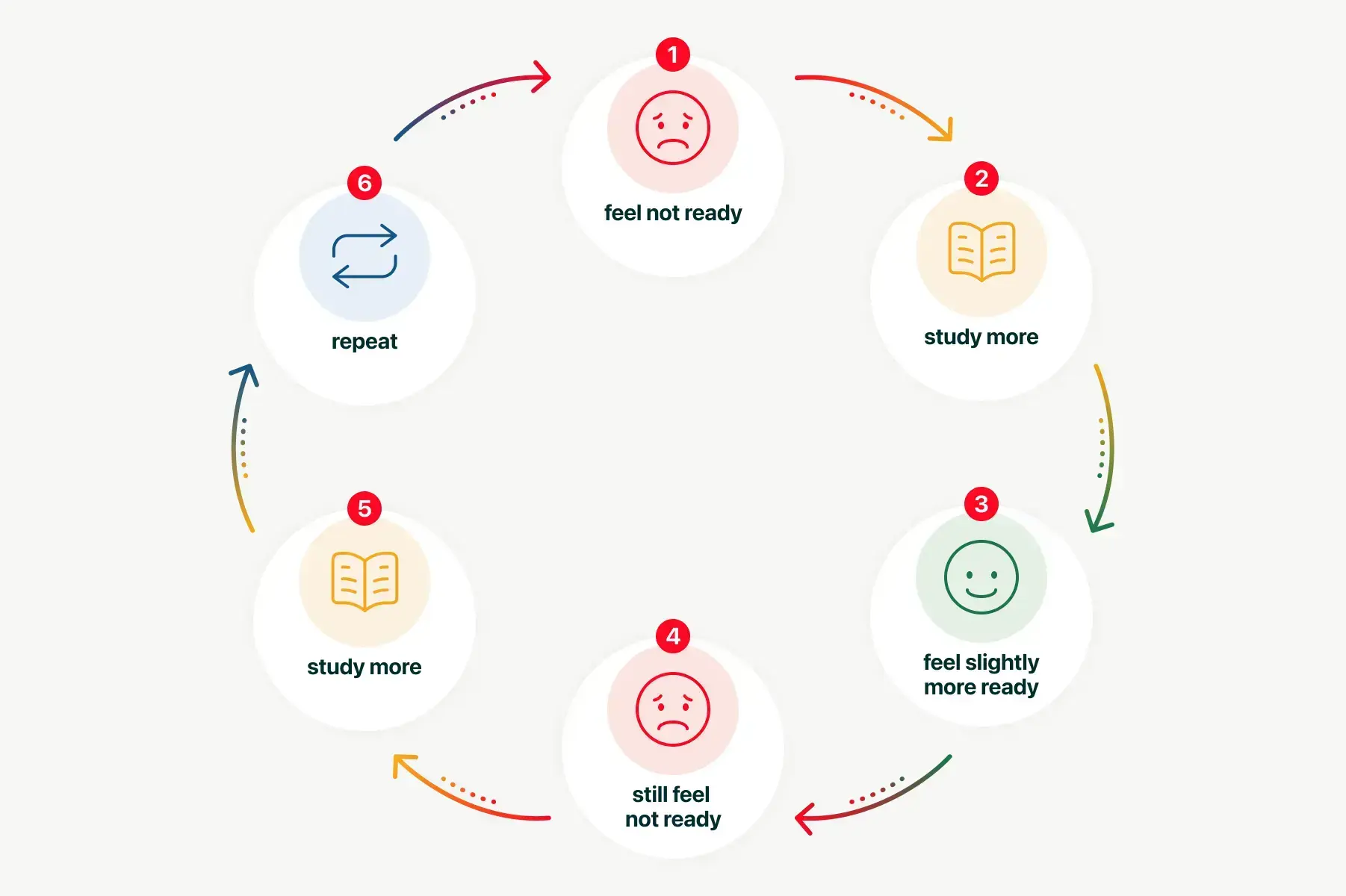
The "ready" feeling never comes. Not because you're not good enough — but because speaking confidence only comes from speaking. You can't study your way into it.
Weeks turn into months. The knowledge accumulates. The fluency doesn't.
I've watched this happen to brilliant, motivated people. The issue was never ability. It was that nobody gave them a place where speaking felt safe enough to actually start.
Why I changed my mind about AI
I'll be honest: I was skeptical.
My whole career has been built on real human interaction — the back-and-forth of a live conversation, the raised eyebrow when you mispronounce something, the awkward pause that forces you to push through. I believed that pressure was essential. Take it away, I thought, and you take away the thing that actually makes you grow.
So when students started telling me they were using AI to practice speaking, I listened politely and assumed it was a shortcut. Something that felt productive without actually being productive.
Then I started watching what happened to the students who used it consistently.
They were getting unstuck. People who had been circling intermediate for two, three years were starting to move. When I asked what changed, the answer was almost always the same: I finally started speaking every day.
That's when I realized I'd misunderstood the problem. Social pressure wasn't pushing people forward — it was stopping them from practicing at all.
Remove the fear of judgment and something opens up. The discomfort is still there — the searching for words, the mistakes. What's gone is the audience for those mistakes. For most people, that's the only thing that needed removing.
"I started using AI to practice speaking without believing it would work. Thirty days later I had a difficult call with my manager — in English, unscripted — and didn't freeze once. The tool didn't matter. The daily speaking did."

What one month actually looked like
I saw this most clearly in one student.
A project manager in her mid-thirties, she had a very specific fear: speaking at work. Every time she had to present or take a client call, something froze inside her. She knew what she wanted to say. The words just wouldn't come.
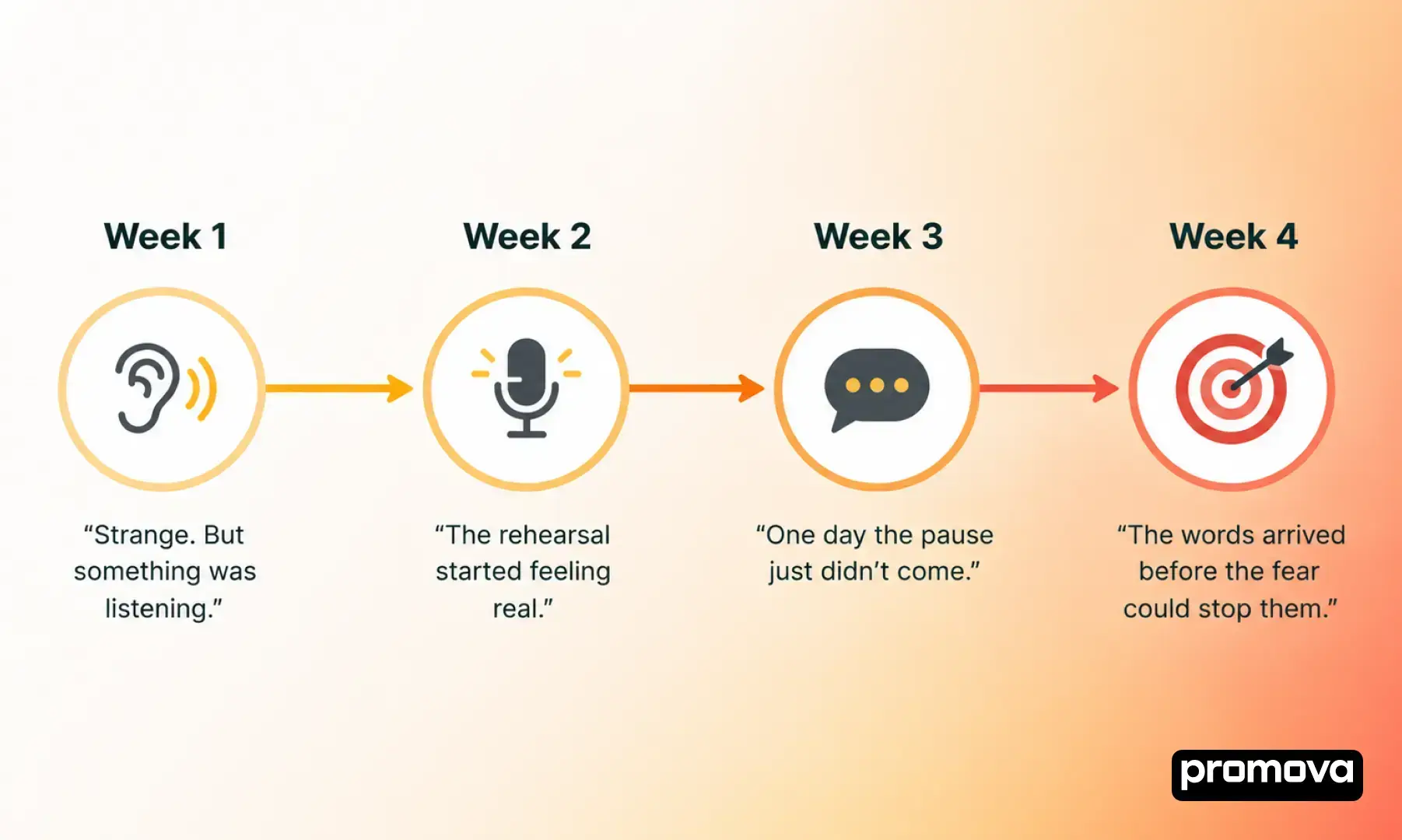
She started daily AI speaking practice — she used the Promova app. Here's what that month looked like from the inside.
Week 1
She started small — client call scenarios, five to ten minutes in the morning before work. The AI advanced the conversation and provided her feedback at the end. Specific feedback. Not "good job" — actual corrections on phrasing and sentence structure. She told me it felt strange at first. "Like talking to myself, but something was listening." She almost stopped after Day 3 because it felt too easy. She kept going.
Week 2
She moved to presentations and negotiations. She started fitting sessions into gaps — during lunch, in the car on the way to pick up her daughter from kindergarten. Some days ten minutes. Some days close to an hour. The scenarios were practical enough that she'd sometimes practice a real conversation she had coming up that week.
Week 3
Something shifted. Not dramatically — she didn't suddenly become fluent. But she noticed she was pausing less. Searching less. One afternoon she finished a client call and realized she hadn't translated a single sentence in her head. She'd just talked.
Week 4
Her colleagues started telling her they understood her more clearly. She stopped freezing before presentations. The anxiety didn't disappear — but it stopped winning. The words were arriving before the fear could stop them.
That's the threshold. That's what crossing from intermediate to advanced actually feels like — not a sudden leap, but a gradual loosening of something that had been locked for years.
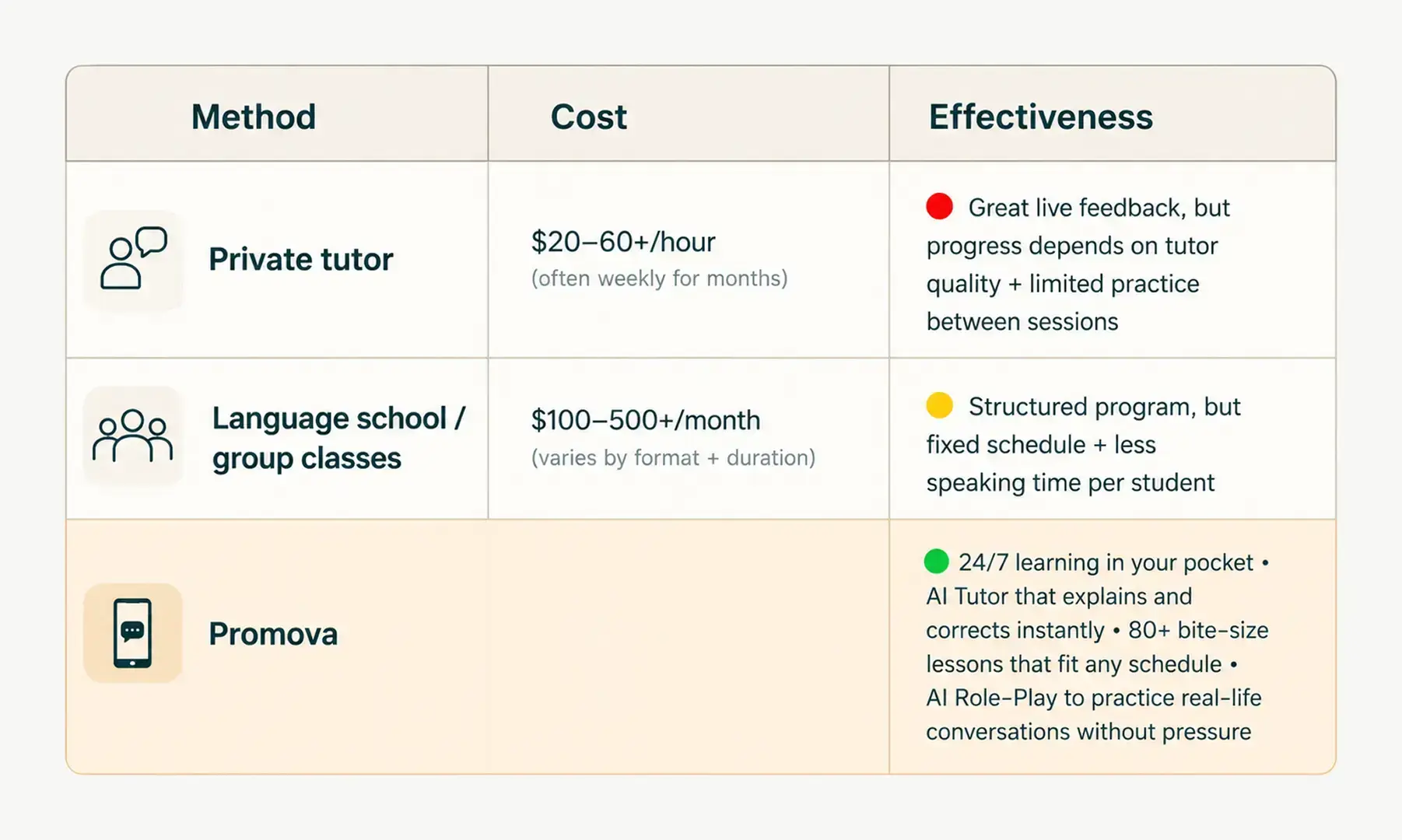
Different learners, different paths through the same stage
My current advice: please don't add more input. Don't study more grammar. Don't download another vocabulary app. Find out exactly where you are on the speaking dimension — and start there.
The students who get unstuck don't all use the same approach. What they share is this: they found a way to practice speaking that didn't feel socially exposing — and then they did a lot of it.
Some need structure first. A clear, sequenced plan where every session has a defined purpose — grammar, vocabulary, speaking — building on the previous one. No guessing what to do next. Just follow the path.
Some need volume. They know what to practice; they just need more repetitions at low stakes. The same scenario ten times, until the hesitation stops. Whatever situation they're preparing for — a job interview, a difficult conversation with a manager, small talk with strangers — available on demand, any time, no scheduling required.
The tool matters less than the principle. You have to start speaking before you're comfortable. Any approach that gives you a genuine, low-stakes space to do that — and then keeps pushing you to do more — will work.
Find out exactly why you're stuck — not just where
If you recognized yourself anywhere in this article — the years of studying, the fluency that still doesn't come — the test is where to start.
Most diagnostics will tell you "you're B1." That's not the revelation. The revelation is understanding why you've been B1 for three years despite studying consistently — which specific gap is actually holding you back, and what kind of practice will close it.
The test does exactly that. Two minutes. A few questions about how you learn, where you get stuck, and which situations feel hardest. It identifies your specific speaking stage and the pattern that's keeping you there.
Step 1 - take the test. Identify your specific speaking stage and the gap behind it.
Step 2 - get your plan. A personalized Promova program built around your exact gaps and schedule.
Your next step
Find out why you're stuck
New users get 43% off when they complete the test. Discount applied automatically.

About the author
Arthur Sterling
Applied Linguist and Language Acquisition Specialist, PhD in Cognitive Linguistics
Arthur has spent 40+ years helping adult learners get unstuck. Former ESL department chair at two universities, author of three books on second-language acquisition, and the person you want in your corner when you're one plateau away from giving up. He writes about what actually works — not what sounds good in a syllabus.
More from Mindpost

I spent years hiding my accent. Here's what I wish I'd known instead.
The problem was never the accent. It took me a long time to understand what the actual problem was.

I understood English perfectly. I just couldn't make myself speak it.
Three years of lessons, one embarrassing work call, and the thing that finally changed.

Why you've learned English for years and still go silent — and how AI conversations fix it?
You've done the lessons. You understand most of what you read.