
What 30 days of daily journaling actually does to your thinking

Not the Instagram version with the leather notebook. The real, unglamorous process — and the quiet changes it produces inside your head.
Most people who try journaling quit within a week. The pages feel forced, the writing stilted, the whole exercise vaguely embarrassing. What nobody tells you is that this is exactly what it's supposed to feel like at the start — and that something genuinely strange begins to happen around day ten, if you stay with it.
This isn't about gratitude lists or manifestation. It's about what consistent, daily writing does to the actual structure of your thinking — and why the effects tend to surprise even the most skeptical practitioners.
What the research actually says
The scientific case for journaling is stronger than its soft reputation suggests. Psychologist James Pennebaker spent decades studying what happens when people write about their inner lives. His findings, replicated across dozens of studies, are striking: expressive writing reduces intrusive thoughts, lowers anxiety, and improves working memory — the cognitive resource you use to hold and manipulate information while thinking.
The mechanism isn't mysterious. When you write something down, you offload it from active mental processing. The brain stops cycling it as an unresolved loop. Pennebaker called this "cognitive unburdening" — and its effects show up not just in mood, but in measurable thinking performance.
The research:
A study at the University of Chicago found that students who journaled about their anxieties before a high-stakes exam scored significantly higher than those who didn't. Writing about the fear, rather than suppressing it, freed up cognitive resources for the task itself. The journal didn't calm the anxiety — it moved it off the mental desk.
What actually happens, week by week

The changes aren't dramatic or linear. They accumulate quietly, and most people only notice them in retrospect — when they re-read an entry from two weeks ago and realize they would write it completely differently now.
Days 1–3: The performance phase
Most people write for an imagined audience at first — editing themselves, reaching for profound-sounding sentences. The entries feel hollow. This is normal. You're still warming up to the idea that this is a private space with no one to impress.
Days 4–7: The friction drops
Writing starts to feel less like a task and more like a continuation of thinking. You begin noticing what's actually on your mind, rather than what you think should be on your mind. Small, honest observations start appearing on the page.
Days 8–14: Patterns emerge
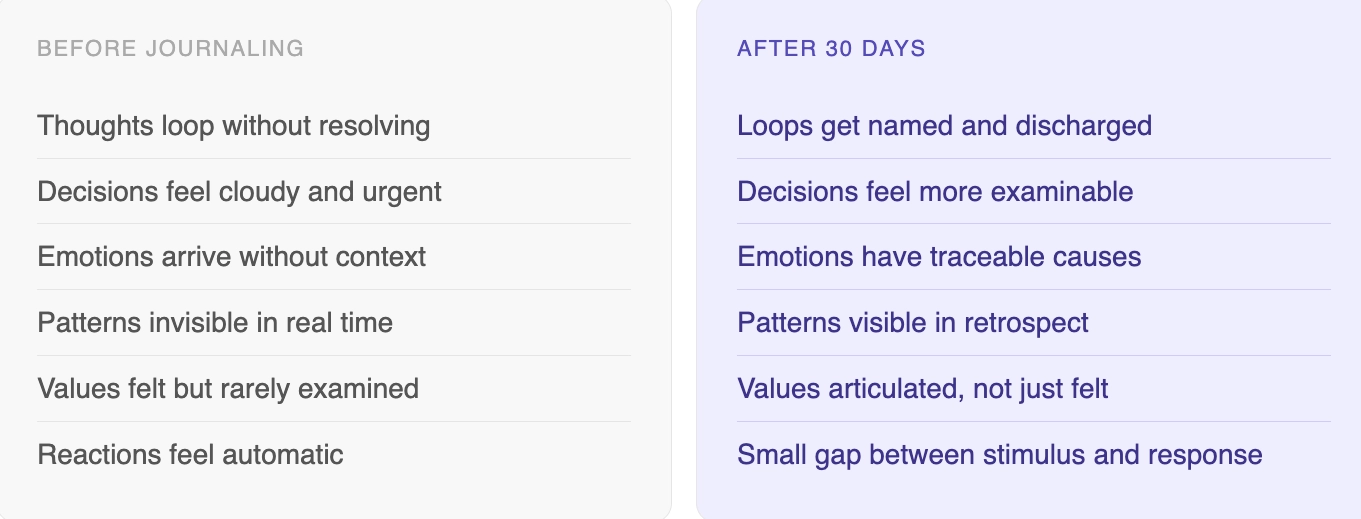
This is when journaling starts earning its reputation. You begin noticing that you've written about the same worry three times in five days — a loop you weren't consciously aware of. Or that a tension you attributed to work is consistently tied to a specific relationship. The journal becomes a mirror with better resolution than your own memory.
Days 15–21: Thinking slows down — in a good way
Writing forces a pace that the rushing mind resists. You can only process one thought per sentence. This deceleration, practised daily, starts bleeding into the rest of your thinking. Decisions that once felt urgent begin to feel more examinable. Reactions that would have been instant slow down just enough to become choices.
Days 22–30: The voice clarifies
By now the internal editor has largely stepped back. What remains is closer to how you actually think — less polished, more precise. Many people find at this stage that their values have become clearer: what actually matters to them, separate from what they've been told should matter. This is perhaps the most significant change, and the hardest to describe from the outside.
Before and after: what actually shifts
What it won't do
It's worth being honest about the limits. Journaling is not therapy. It won't resolve trauma on its own, and for some people — particularly those prone to rumination — unstructured expressive writing can amplify anxiety rather than reduce it. If writing about a problem tends to make you spiral rather than clarify, a more structured prompt-based approach tends to work better.
Writing about a feeling and wallowing in it look identical on paper. The difference is whether the pen is moving toward understanding or deeper into the fog.
It also won't tell you what to do. The journal surfaces what's already there — the values, the patterns, the unresolved tensions. Making decisions with that information is still your job.
How to actually start (and not quit)
The format matters less than the consistency. That said, a few things dramatically improve the odds of making it to day 30:
Write by hand if you can. The slower pace of handwriting naturally extends each thought rather than compressing it. Type if you won't do it any other way.
Set a time limit, not a word count. Five minutes every morning beats an ambitious nightly ritual that collapses on busy days. The quantity of writing is irrelevant. The frequency is everything.
If you don't know what to write, use a prompt. Blank pages are harder than they look. Some starting points that tend to produce genuine thinking rather than performance:
What am I not saying out loud right now — and why?
What was I wrong about this week?
What do I keep almost doing, but not quite?
What would I do differently if no one's opinion of me were at stake?
What is taking up more mental space than it deserves?
Worth knowing
You don't have to keep what you write. Many people find journaling more honest when they know they'll delete or destroy the entry afterward. The purpose is the thinking, not the archive. The act of writing still produces the cognitive benefits, whether or not the page survives.
The thing that surprises people most
Almost everyone who completes 30 days of journaling says the same unexpected thing: they became better listeners. Not because journaling teaches listening — but because the daily practice of paying close attention to their own thinking makes them more capable of paying close attention to someone else's.
The same quality of unhurried observation you bring to a page, you start bringing to conversations. The same willingness to sit with an incomplete thought rather than reaching for a quick conclusion. The journal, in the end, is just a training ground for a particular kind of attention — one that turns out to be useful everywhere.
You write to find out what you think. After thirty days, you start finding out you think more clearly than you gave yourself credit for.